

NANNE SPRINGER: FORGING CREATIVE COLLABORATIONS
Words: Colleen Creamer
By trade, Springer, who lives in Montreal, Canada, is a successful architectural photographer. For personal fine-art projects, however, she shoots analog only, preferring medium format. “It’s easier to print medium format in my darkroom,” she says. “My partner Frédéric and I have a darkroom in the living room. The setup is pretty weird-looking. It’s a couch and a TV, and everything else is related to a darkroom.”
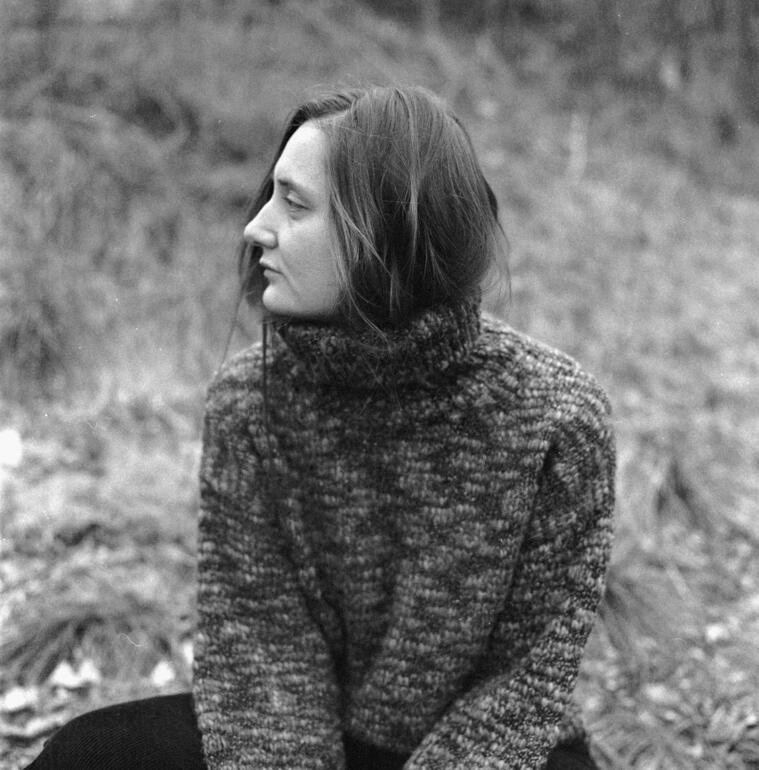
Nanne Springer. Photo By Frédéric Arthur Chabot
Her architectural work is in color “for obvious reasons.” She argues that color is for “a less imaginative mind,” yet her built-environment work has an almost astonishing self-confidence—lush and gorgeous. But it’s her curiosity with black and white that is ever evolving and ever lively. “I always shoot medium format for black and white. I was never really into 35mm, because you shoot from the hip; you sort of have to not care, but I do care—a lot. I want to take my time. I want to see well, and you can see so well through a medium-format viewfinder.”
Gear aside, Springer collaborates with other artists for her black-and-white work. She is driven by curiosity about what people hope to uncover or express during synergistic moments in front of camera. Growing up in rural Germany left a profound impact on her and shaped a view of the mystery of the natural world that she still retains.
Gear aside, Springer collaborates with other artists for her black-and-white work. She is driven by curiosity about what people hope to uncover or express during synergistic moments in front of camera. Growing up in rural Germany left a profound impact on her and shaped a view of the mystery of the natural world that she still retains.
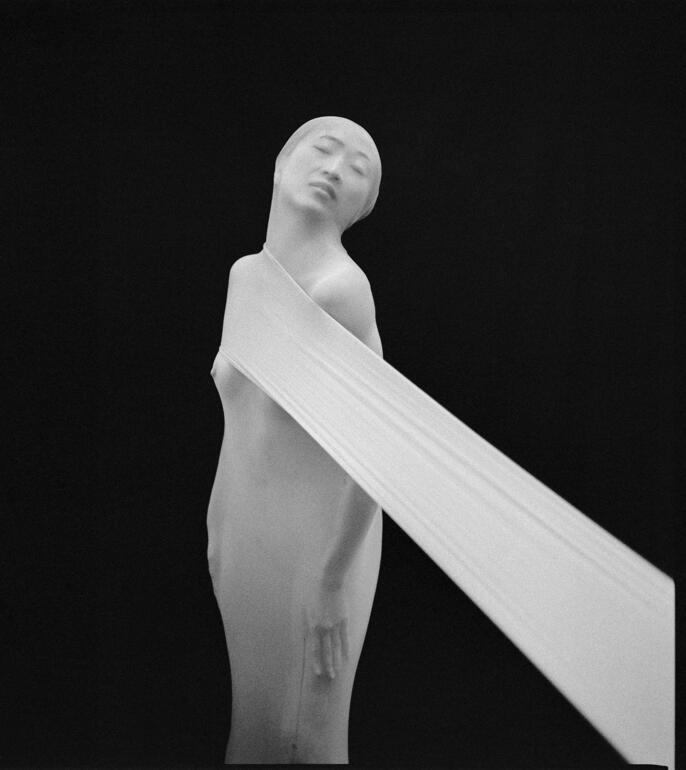
Miranda Chan, Movement Artist, Director
“I grew up in the Thüringer Wald, the Thuringian Forest, a mountain range in the southern part of Thuringia,” she says. “It’s a landscape that leaves a deep impression: dense forests, quiet valleys, shifting light, mushroom picking, swimming in little lakes, playing in small creeks. I feel a strong connection to nature because of that. It’s something that often finds its way into my work, consciously or not. There’s a constant longing in me to return to nature, and to meine heimat, my home.”
Springer collaborates with poets, dancers, circus performers and visual artists, based mostly in Canada, Iceland, Scotland and Germany. Many know of her work and reach out.
Springer collaborates with poets, dancers, circus performers and visual artists, based mostly in Canada, Iceland, Scotland and Germany. Many know of her work and reach out.
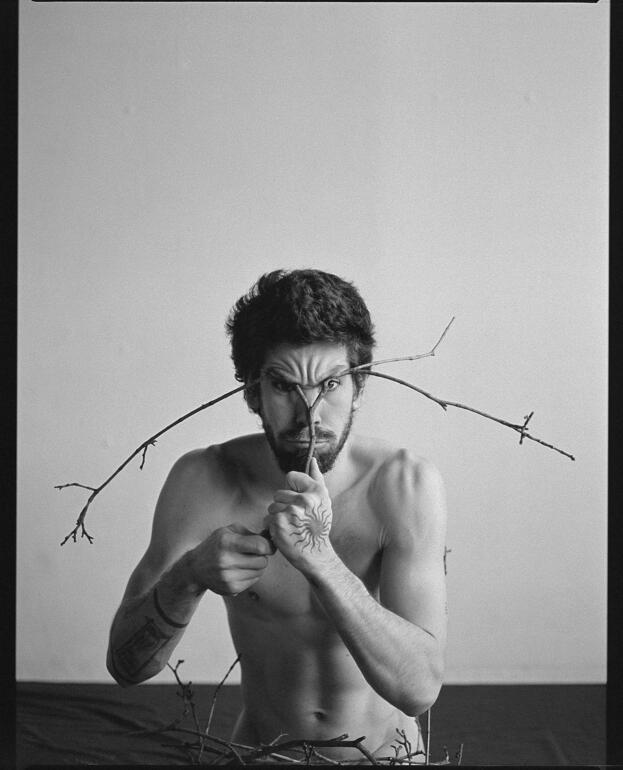
Mathieu G-Lauzon, Storyteller
“When someone writes to you who really wants to meet and work with you, you can pretty much figure out what they want to achieve/attempt in a session. I look for people who are obsessed with what they’re doing, who want to have this experience with me. It is about meeting that person and having that day together.”
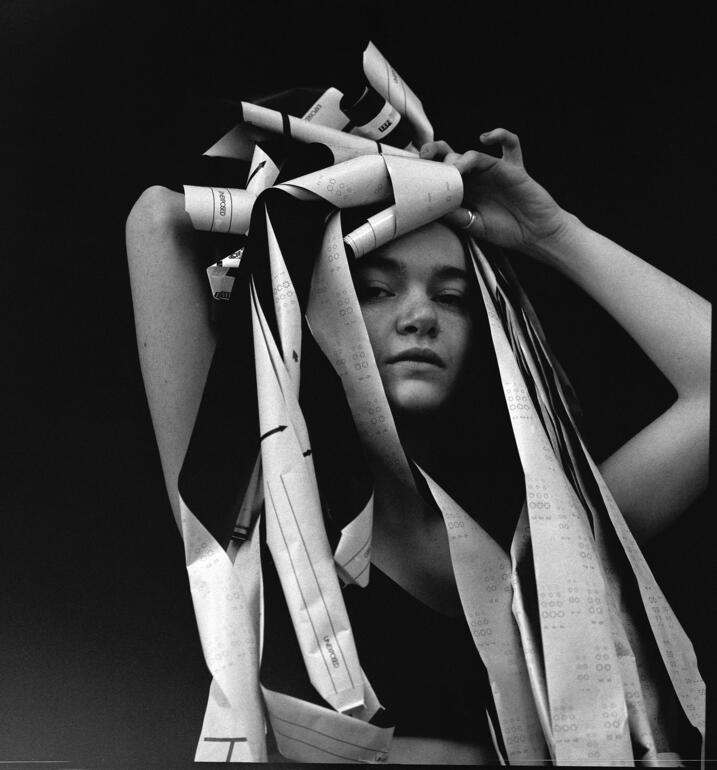
Typically disdaining a fixed plan, Springer prefers a “hook,” a small starting idea, sometimes using an artifact brought by the artist. For the photograph of Clara-Jane Rioux Fiset, the subject, a fiber artist, brought a handmade piece of fabric. The image—depicting her face blurred by a delicately woven piece of linen and paper thread dyed with plants that she had harvested—is simple but evocative, made more so by a wrinkle in the fabric. Even the mere expectation of getting into the zone can be tricky for Springer. But working with artists who love what they do as much as she does provides a kind of platform for play—a type of art improv.
Typically disdaining a fixed plan, Springer prefers a “hook,” a small starting idea, sometimes using an artifact brought by the artist. For the photograph of Clara-Jane Rioux Fiset, the subject, a fiber artist, brought a handmade piece of fabric. The image—depicting her face blurred by a delicately woven piece of linen and paper thread dyed with plants that she had harvested—is simple but evocative, made more so by a wrinkle in the fabric. Even the mere expectation of getting into the zone can be tricky for Springer. But working with artists who love what they do as much as she does provides a kind of platform for play—a type of art improv.
Nanne Springer, Autoportrait
“I ask if they have an idea in mind,” she says. “Sometimes they do and sometimes they don’t, but we almost always can find a way to start to play. Because they are all artists and come from different fields and have a different set of ideas of how wide their field is, I take advantage of this. I work with a lot of circus artists, who are some of the wildest, most open people you will meet. That is a nice thing to have in your life. You wind up in this spiral of excitement. You are really in the moment. That’s what it is about, but if you are just hunting for that thing in your head, you will never get it.”
The opening-spread image of Miranda Chan (movement artist/director) portrays a woman wrapped in what looks like a “cocoon,” in keeping with Springer’s often-alluded to idea of becoming—or becoming something else. “I initially titled it The Cocooning because I was thinking of the butterfly cocoon, the chrysalis, but it also worked in the sense that we were in a pandemic,” she says. “Most people were staying home inside their nests. Another person present during the session, the visual artist and dancer Daria Mikhailiuk, was pulling the fabric close to the camera to create the effect of the viewer being tethered to this emerging cocoon.”
The opening-spread image of Miranda Chan (movement artist/director) portrays a woman wrapped in what looks like a “cocoon,” in keeping with Springer’s often-alluded to idea of becoming—or becoming something else. “I initially titled it The Cocooning because I was thinking of the butterfly cocoon, the chrysalis, but it also worked in the sense that we were in a pandemic,” she says. “Most people were staying home inside their nests. Another person present during the session, the visual artist and dancer Daria Mikhailiuk, was pulling the fabric close to the camera to create the effect of the viewer being tethered to this emerging cocoon.”
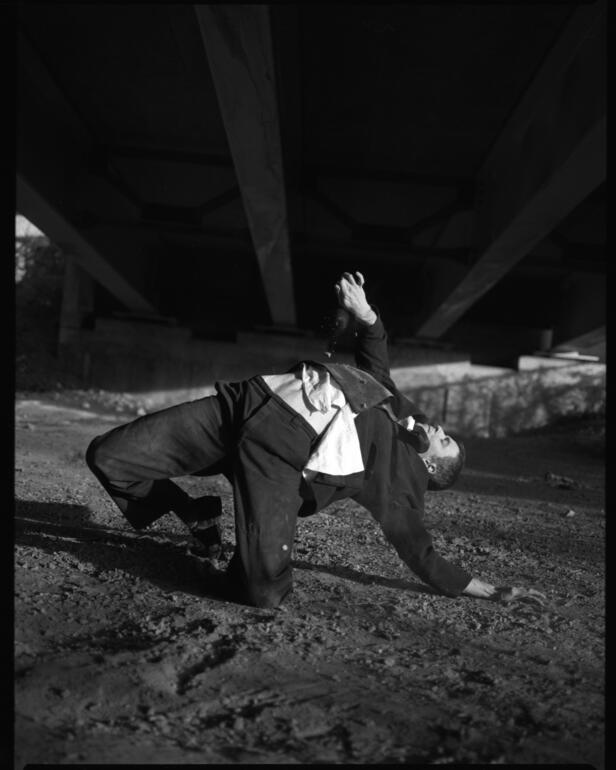
Brin Schoellkopf, Director, Performance Artist, Photographer
Springer received her Bachelor of Arts in Economics and Scandinavian Studies at the University of Greifswald, Germany. She moved to Canada from Germany in 2010. Her origin story also has to do with darkness and light. During an internship in Sweden, Springer was dealing with loneliness and depression, eventually finding solace in a small point-and-shoot camera. As for black and white being the foundation for her work, Springer believes that a monochromatic approach suits, and in fact fosters, a wider field of imagination.
“We live our daily lives in color, and color feels loud, wild and fast,” Springer says. “If you need everything served as you know it on a platter, then your inner world seems less creative. Black and white quiets things down, lets reality slip more easily into a dream, like looking through a veil. On a practical level, black and white also suits my process. I develop my own film and make my own prints. With color, I can only develop the negatives. I don’t have the knowledge or equipment to print color enlargements myself. Black and white gives me both creative freedom and hands-on control.”
“We live our daily lives in color, and color feels loud, wild and fast,” Springer says. “If you need everything served as you know it on a platter, then your inner world seems less creative. Black and white quiets things down, lets reality slip more easily into a dream, like looking through a veil. On a practical level, black and white also suits my process. I develop my own film and make my own prints. With color, I can only develop the negatives. I don’t have the knowledge or equipment to print color enlargements myself. Black and white gives me both creative freedom and hands-on control.”
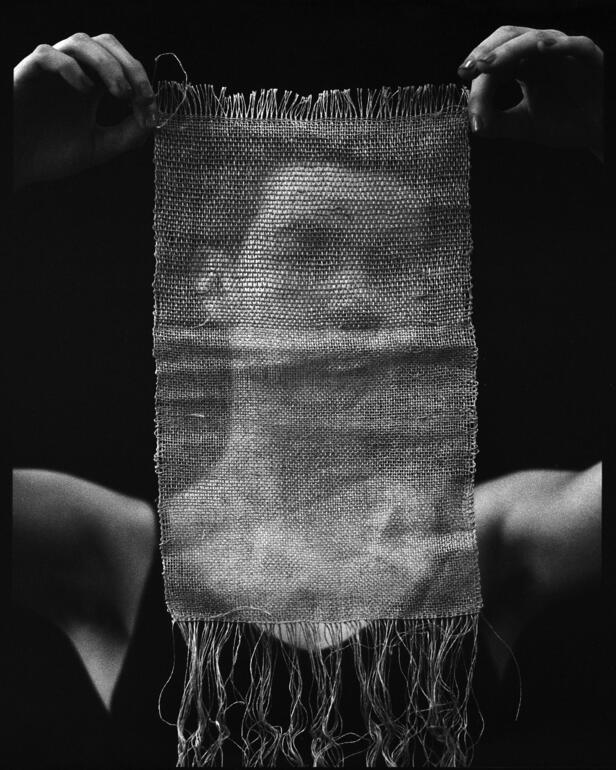
Clara-Jane Rioux Fiset, Artist
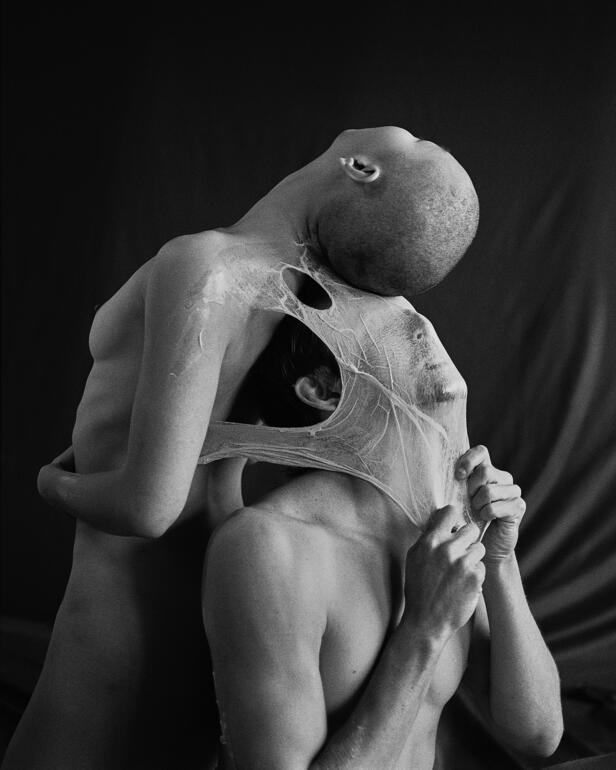
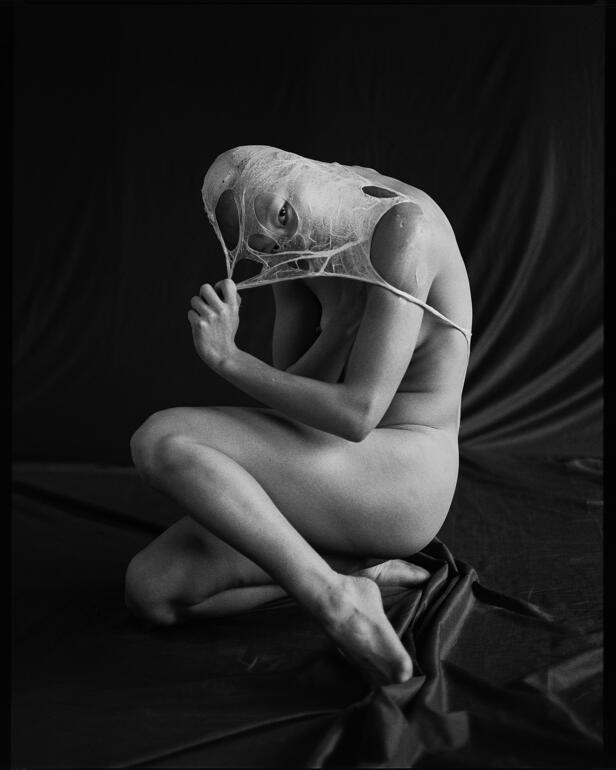
Elements that become inspiration or are directly used in Springer’s images can be or consist of anything. She is particularly drawn to skin, evidenced by the two photographs on page 43 of Brin Schoellkopf (director/performance artist/photographer) and Evelynn Yan (dancer/artist)
“I found this material used in special effects. When I started playing with it, I realized that if I spread it really thin, I could actually peel it off. For a moment, it becomes quite strong—strong enough to use. I first invited one friend to try it out, but later realized that if I invited two people to connect through this material, I could explore the idea of a shared skin.” The top image evokes a sense of the two artists literally crawling under each other’s skin. The phrase “makes one’s skin crawl” came to Springer’s mind.
“I found this material used in special effects. When I started playing with it, I realized that if I spread it really thin, I could actually peel it off. For a moment, it becomes quite strong—strong enough to use. I first invited one friend to try it out, but later realized that if I invited two people to connect through this material, I could explore the idea of a shared skin.” The top image evokes a sense of the two artists literally crawling under each other’s skin. The phrase “makes one’s skin crawl” came to Springer’s mind.
Jeremy Cline, Artist
“I want to emphasize that I offer only a small nudge, just a simple idea,” Springer qualifies. “The photographs themselves come from my subjects, out of them. I have such admiration for circus artists and the artists I work with in general. You can give them the tiniest bit of inspiration without being too descriptive, and they’ll create something incredible. You just stand there in awe. A frame can offer the world.”
She leans to Ilford FP4 film for its “silvery quality,” but still yearns for a former iteration of ORWO. “The first time I made my own prints was in the darkroom of a friend of my father’s. He gave me a 20-minute tour and then left me to figure out the rest on my own. I printed everything on ORWO paper, which has its own fascinating history; it was founded in 1964 in the former East Germany. Even today, I still try to get my hands on old ORWO film, even though much of it expired decades ago.”
She leans to Ilford FP4 film for its “silvery quality,” but still yearns for a former iteration of ORWO. “The first time I made my own prints was in the darkroom of a friend of my father’s. He gave me a 20-minute tour and then left me to figure out the rest on my own. I printed everything on ORWO paper, which has its own fascinating history; it was founded in 1964 in the former East Germany. Even today, I still try to get my hands on old ORWO film, even though much of it expired decades ago.”
Brin Schoellkopf and Evelynn Yann
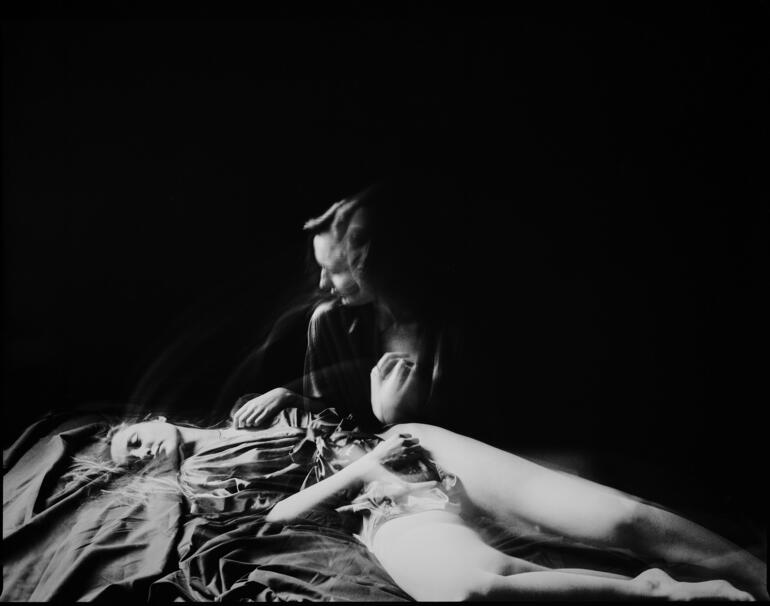
At times, Springer uses her own body for visual exploration, as in the two autoportraits on page 39. In the top photo, she is lying down on what looks like a fog of fabric, an effect conjured by having the material moved during a long exposure. The bottom photograph presents two selves, one lying down and one getting back up, giving the impression of a ghostly double gazing down on her sleeping self. For Springer, this kind self-portraiture can be an avenue into a kind of appreciation foreign to many in the West who are bombarded with images of a beau ideal.
“Everyone has problems with self-confidence about their bodies,” Springer reflects. “I think that self-portraiture has helped me to be fine with my body. I’ve been photographing it since 2007; I have chronicled what has happened to it. You know what? It looks great. It looks sort of romantic. People should take a camera and forgive themselves, and just let the camera help you to fall in love with your own body.”
“Everyone has problems with self-confidence about their bodies,” Springer reflects. “I think that self-portraiture has helped me to be fine with my body. I’ve been photographing it since 2007; I have chronicled what has happened to it. You know what? It looks great. It looks sort of romantic. People should take a camera and forgive themselves, and just let the camera help you to fall in love with your own body.”
Evelynn Yan, Dancer, Artist
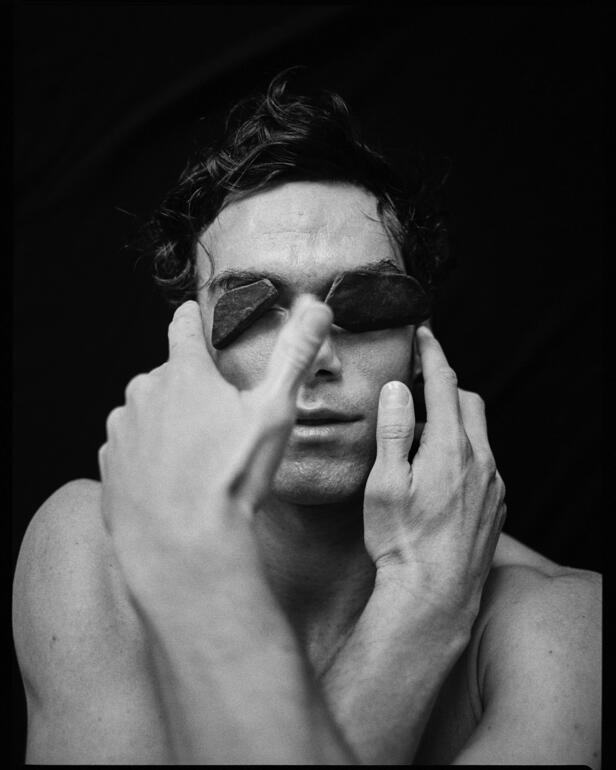
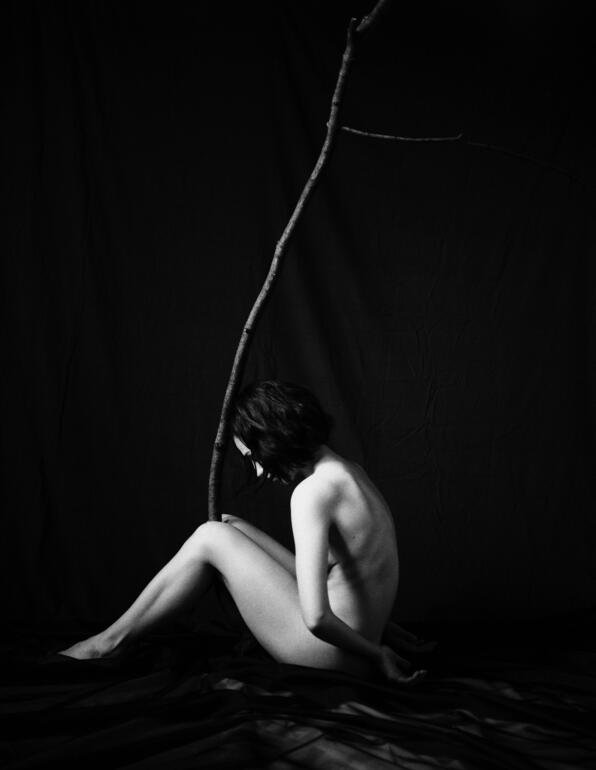
Also drawn to using natural elements like rocks and branches, Springer sometimes “picks things up” on the way to a shoot, as in her photograph of artist Jeremy Cline. A less-attuned photographer may not have intuited how capturing his crossed hands and the small stones resting against his eyes lends an additional level to his macabre “dance” for the camera.
“Let’s say you describe a scene: You can see a field in the distance, or some trees, or some birds flying, but your mind won’t add a human to the setting. We are seen as the destroyers of nature,” Springer explains. “But if we see ourselves in it and part of it, it’s a healthier perspective, and maybe helps us understand how much we need to protect the natural world. I like bringing nature inside a human-made space. I like to bring nature and humans together, as we often don’t see humans as nature.”
“Let’s say you describe a scene: You can see a field in the distance, or some trees, or some birds flying, but your mind won’t add a human to the setting. We are seen as the destroyers of nature,” Springer explains. “But if we see ourselves in it and part of it, it’s a healthier perspective, and maybe helps us understand how much we need to protect the natural world. I like bringing nature inside a human-made space. I like to bring nature and humans together, as we often don’t see humans as nature.”
Léa Noblet Di Ziranaldi, Dance Artist
Elements of creativity run in Springer’s family. Her mother is a special needs teacher with a focus on art. Her father, a blacksmith at the Schilling Forge in Suhl, Germany, established in 1862. “It’s a remarkable place—dark, full of the smell of fire, metal and machinery. It’s where we grew up since I was seven years old. That atmosphere, the weight of tradition and craft, had a big influence on all of us.”
After returneing to Germany following her Sweden internship, Springer did a deep dive into analog. But when she sent her negatives to be developed, they weren’t carefully handled. Hence, she learned how to develop film herself, and then mastered the complete process from shooting to printing.
After returneing to Germany following her Sweden internship, Springer did a deep dive into analog. But when she sent her negatives to be developed, they weren’t carefully handled. Hence, she learned how to develop film herself, and then mastered the complete process from shooting to printing.
Clara-Jane Rioux Fiset, Artist
“These days, I print mostly on Ilford Multigrade Matte Fiber paper. I love how it renders blacks—soft, rich, tactile. The matte surface helps achieve that quiet, gentle mood I’m after. Everyone prints differently. By talking with Frédéric, I noticed that I print for the whites in the photograph. The black follows. I don’t mind a darker image, as long as the white has the focus and detail. Once the prints are dry, we use a press at home to flatten them, and then they’re carefully stored in boxes. And then…we will see.”
Unbothered by change, and decades past the training that she hoped would pave the way for a different life, Springer is characteristically accepting about the turn her life has taken. “While I was studying something else,” she says, “I found something I wanted to do for the rest of my life.”
Unbothered by change, and decades past the training that she hoped would pave the way for a different life, Springer is characteristically accepting about the turn her life has taken. “While I was studying something else,” she says, “I found something I wanted to do for the rest of my life.”
ADDENDUM: See and learn more at nannespringer.com and instagram.com/nannespringer.