


STEVE FITCH: DIESELS, DINOSAURS AND SIGNS OF LIFE
Words: Stuart I. Frolick
“…the golden land’s ahead of you
and all kinds of unforeseen events wait lurking
to surprise you and make you glad you’re alive to see?”
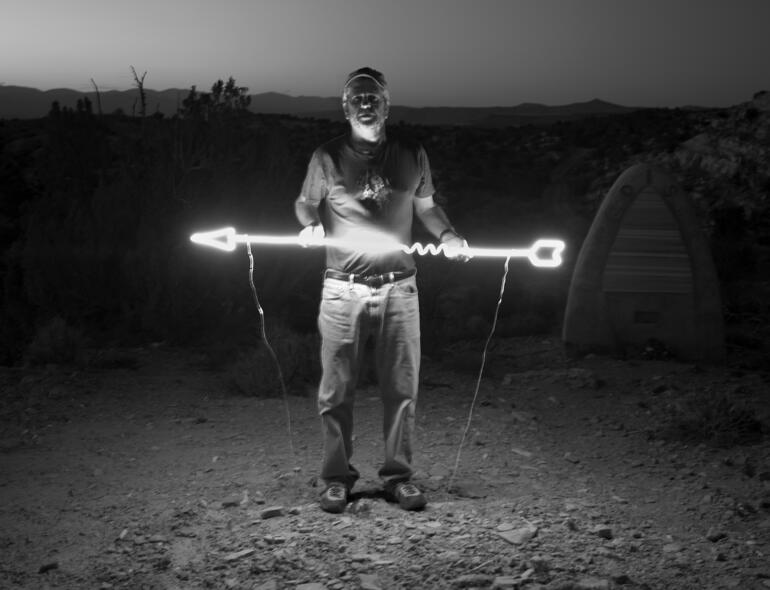
Steve Fitch, Self-portrait, Baja Waldo, New Mexico, 2013
In this, its centennial year, Route 66 has attained iconic status approaching that of The Pony Express. According to True West magazine, the production company responsible for the TV series (1960–’64) never set foot or camera on the actual pavement of Route 66. Yet, the show’s promise of freedom, romance and danger captured the popular imagination nonetheless. All one needed were a buddy and a Corvette convertible to “get your kicks on Route 66.”
Perhaps no photographer of note has documented America’s roadside attractions, many found on Route 66, as well or as comprehensively as Steve Fitch. His is a scholarly approach to art informed by his deep interest in and study of cultural archeology.
Perhaps no photographer of note has documented America’s roadside attractions, many found on Route 66, as well or as comprehensively as Steve Fitch. His is a scholarly approach to art informed by his deep interest in and study of cultural archeology.
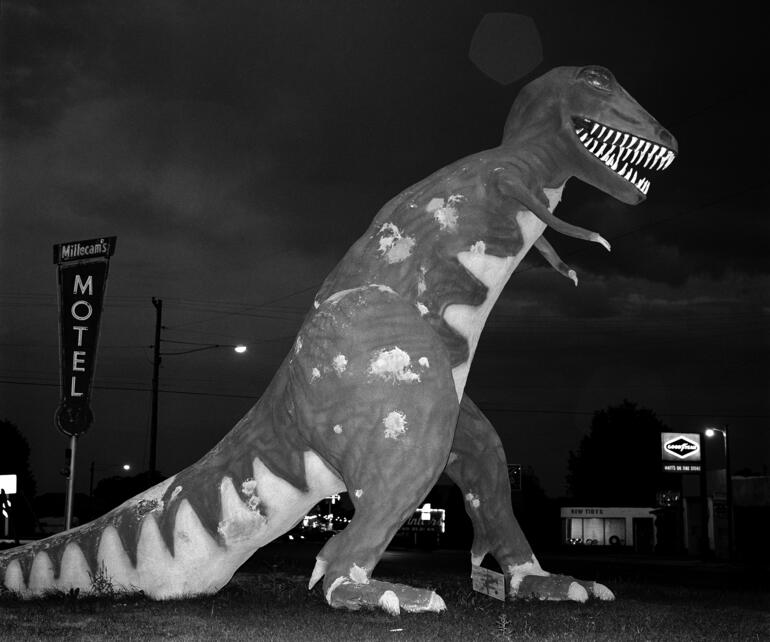
Dinosaur, Highway 40, Vernal, Utah, 1974
Looking at the first of Fitch’s many published books, Diesels and Dinosaurs (Long Run Press, 1976), it’s impossible not to lament the diminishment of the nation’s two-lane highways, and impossible not to enjoy the wonderful expressions of character and creativity Fitch so passionately and presciently documented. Shooting what he calls “vanishing vernacular” continues to occupy a central role in his practice. The signage and roadside objects of his fascination were created during the late 1940s through the 1950s—in the post-WWII American honeymoon with consumerism—cars, refrigerators, rotary telephones, television sets…and travel. From 1946 to 1969, gas cost, on average, 19–35 cents a gallon. The Road beckoned.
In his introduction to Diesels and Dinosaurs, Fitch writes: “Small adventures seemed more than they really were. One time, driving down the shiny-wet street of a small town at dusk with an army of neon reflections bouncing off the slick pavement, I felt akin to an explorer on another planet who has abruptly come upon a canyon as gigantic and majestic as the Grand Canyon—only a canyon of neon light!” A child’s reverie in the age before cell phones.
In his introduction to Diesels and Dinosaurs, Fitch writes: “Small adventures seemed more than they really were. One time, driving down the shiny-wet street of a small town at dusk with an army of neon reflections bouncing off the slick pavement, I felt akin to an explorer on another planet who has abruptly come upon a canyon as gigantic and majestic as the Grand Canyon—only a canyon of neon light!” A child’s reverie in the age before cell phones.
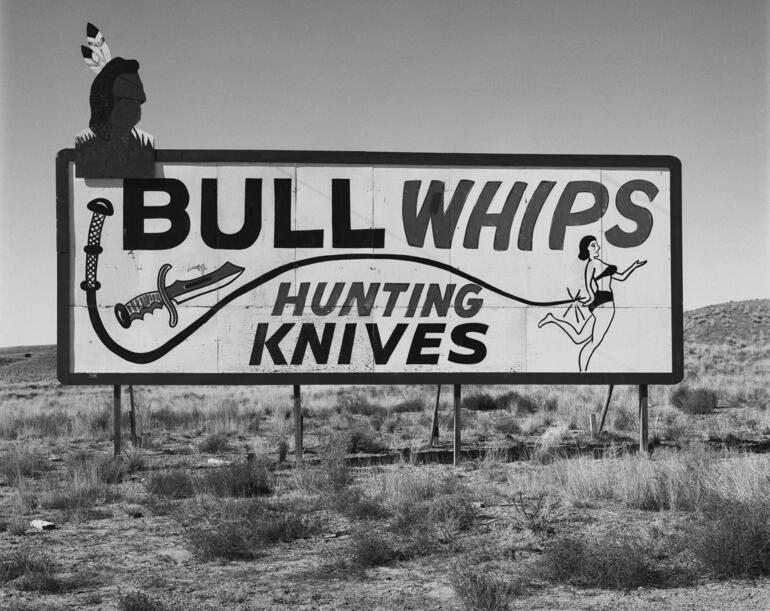
Billboard, Highway 66, West of Albuquerque, 1972
Fitch first followed that ribbon of colored neon lights from the back seat of his parents’ Buick, “with local stations playing on the radio—never knowing what I might see next.” Of the trucks that also appealed to his young imagination, Fitch wrote, “…Modern mules used to transport everything from furniture to missiles, [sometimes] these diesels…parked beside the road, they look like nothing more than kids’ toys.”
Looking back at those early experiences 12 years later, he writes, “The dichotomy was still with me: Which was stronger, the omnipotent, prehistoric fantasy or the modern device, the designed reality?…The question had new contours to it…”
Looking back at those early experiences 12 years later, he writes, “The dichotomy was still with me: Which was stronger, the omnipotent, prehistoric fantasy or the modern device, the designed reality?…The question had new contours to it…”
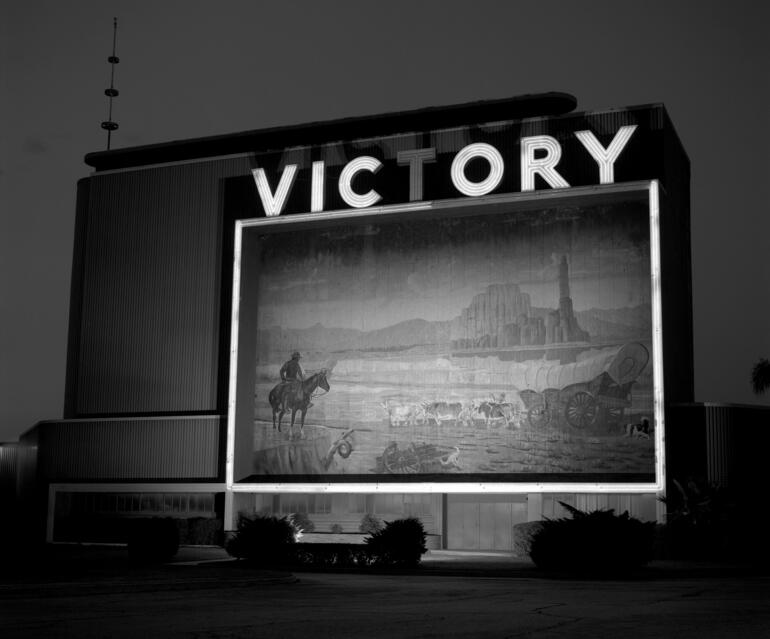
Victory Drive-in Theater, San Fernando Valley, California, 1973
The narrative arc of Fitch’s life includes time in South Dakota, residence in other western states, and many memorable road trips. Raised in northern California’s Mendocino County, Fitch’s earliest influences were his parents—his father wrote poetry, and his mother painted, and often took Steve out into the landscape with her.
“What they taught me, “says Fitch, “was values—what’s worth noticing and appreciating in life.” Based in Santa Fe, Fitch is married to an artist, and their two sons are an architect and a filmmaker. “I’d like to think that those values were passed on to the next generation,” he says.
“What they taught me, “says Fitch, “was values—what’s worth noticing and appreciating in life.” Based in Santa Fe, Fitch is married to an artist, and their two sons are an architect and a filmmaker. “I’d like to think that those values were passed on to the next generation,” he says.
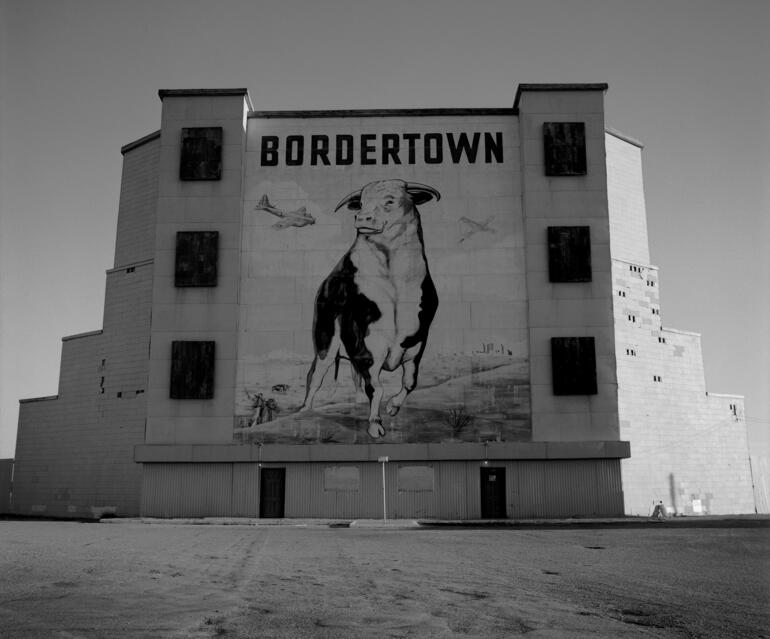
Bordertown Drive-in Theater, Highway 180, El Paso, Texas, 1973
Fitch’s photographic roots are firmly planted in the work of great documentarians of the past. He cites Walker Evans, Robert Frank, and FSA photographers Russell Lee and Marion Post-Wolcott as important influences. Fitch earned an undergraduate degree in Anthropology at Berkeley in 1971, and taught photography for the first time at the ASUC Studio on the Berkeley campus, where his darkroom colleagues included Richard Misrach and Roger Minick.
An MA degree from the University of New Mexico followed in 1978. Since then, he’s taught photography at UC Berkeley, the University of Colorado, the University of Texas at San Antonio, Princeton University, and from 1990–2014 at the College of Santa Fe. He is the recipient of three NEA Fellowships, and in addition to his published books, Fitch has exhibited extensively. Prints of his photographs reside in prestigious collections, including the Museum of Modern Art and the J. Paul Getty Museum.
An MA degree from the University of New Mexico followed in 1978. Since then, he’s taught photography at UC Berkeley, the University of Colorado, the University of Texas at San Antonio, Princeton University, and from 1990–2014 at the College of Santa Fe. He is the recipient of three NEA Fellowships, and in addition to his published books, Fitch has exhibited extensively. Prints of his photographs reside in prestigious collections, including the Museum of Modern Art and the J. Paul Getty Museum.
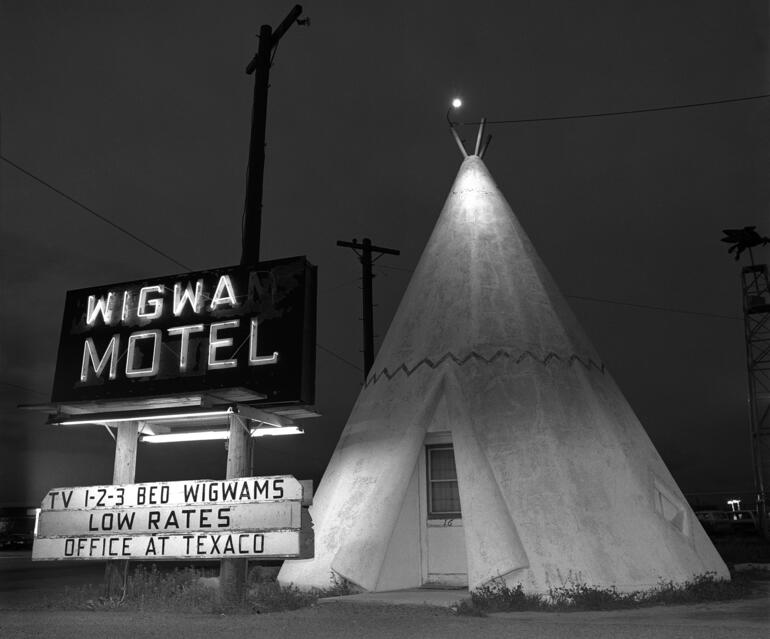
Motel, Highway 66, Holbrook, Arizona, 1973
What’s it like to see work made 50 years ago published again now? Fitch says, “I’m proud of the early work. Very few photographers were shooting pictures like these when I started. I still love black and white, and I’m happy that the pictures in Diesels and Dinosaurs still resonate with people. The project gradually evolved, partly as a rehash of my early childhood trips to South Dakota. It was an Outsider Art type of thing that represented a certain kind of creativity at the time. My interest in photography gave me a way to get out into the world.”
For Fitch, what’s become something of a cliché—that “the journey is the destination,” rings especially true.
For Fitch, what’s become something of a cliché—that “the journey is the destination,” rings especially true.
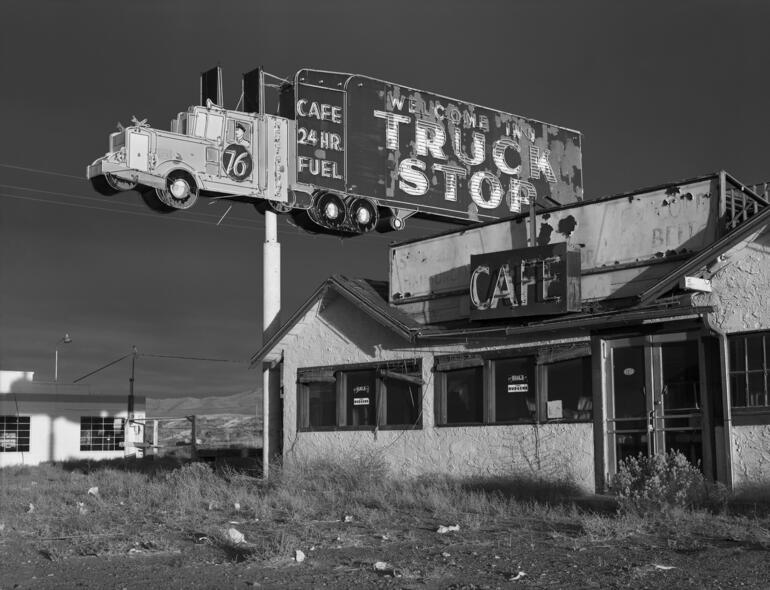
Abandoned Truckstop, Highway I-80, Winnemucca, Nevada, 1970
“I was lucky to find my path…and I feel fortunate to have made as many road trips as I have, and that I’ve been able to document and preserve these pieces of Americana that are now long gone. It was an adventure, and it was fun. I still love taking a two- or three-week road trip with my cameras, which I try to do at least once a year.”
Of his many years teaching college-level photography, Fitch says, “You can teach craft, tools and technique, but you can’t give them the drive…It’s valuable for students to be exposed to other photographers’ work—then, you do your own work, and in the process of doing it, find out what you have to say.”
Of his many years teaching college-level photography, Fitch says, “You can teach craft, tools and technique, but you can’t give them the drive…It’s valuable for students to be exposed to other photographers’ work—then, you do your own work, and in the process of doing it, find out what you have to say.”
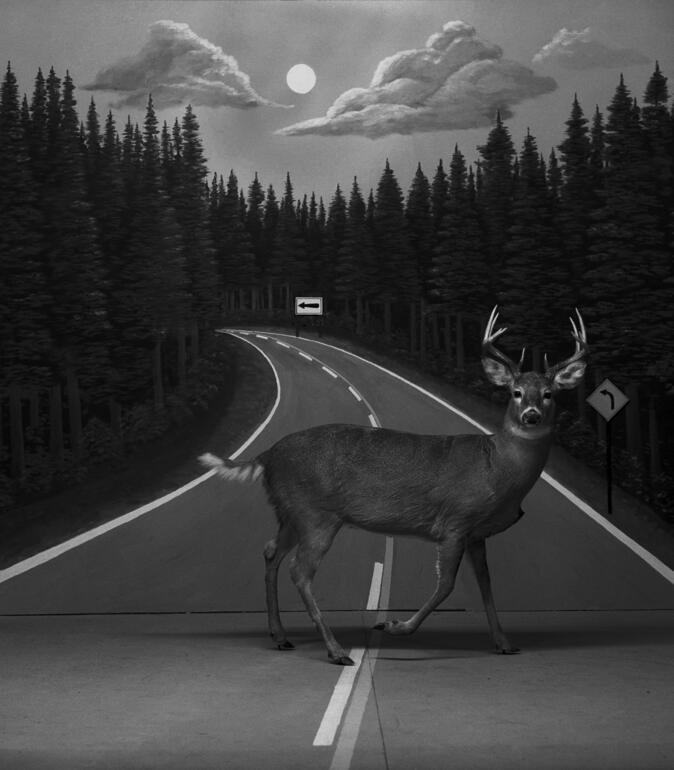
"Call of the Wild" Roadside Museum, Highway I-75, Gaylord, Michigan, 1973
He retired from teaching in 2014, when students still wanted large-format and darkroom technique. “Critiques of a student’s work was always a challenging situation. During the last five to ten years of my teaching career, I gradually grew more comfortable threading the needle of giving criticism as well as support for a student’s work,” he says. “There’s a lot of ego on the line.”
Needless to say, digital changed everything. Fitch says, “The students all had iPhones in class, and the marriage of the phone to the camera and Internet…sharing changed the work. There was a lot more navel gazing. I think students today are less interested in experiencing the photographic print, and more attracted to sharing on screens.”
Needless to say, digital changed everything. Fitch says, “The students all had iPhones in class, and the marriage of the phone to the camera and Internet…sharing changed the work. There was a lot more navel gazing. I think students today are less interested in experiencing the photographic print, and more attracted to sharing on screens.”
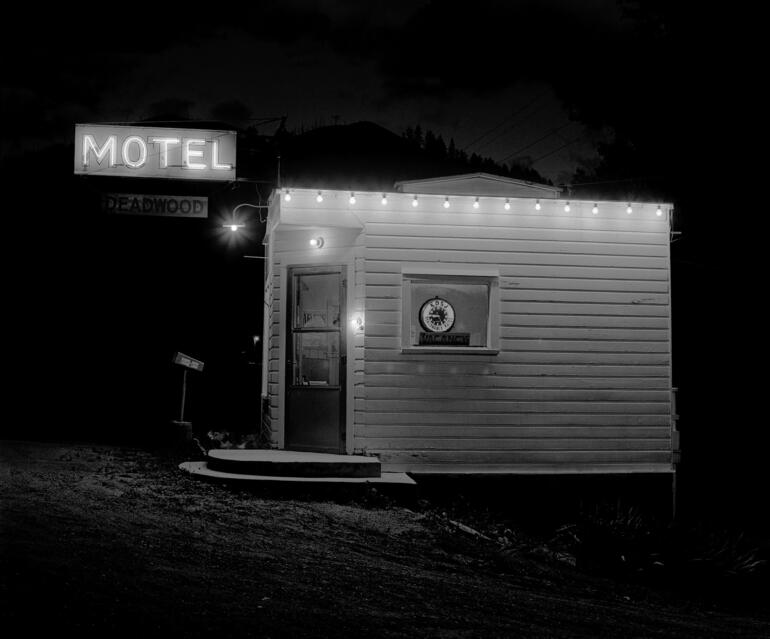
Motel, Deadwood, South Dakota, 1972
One of Fitch’s Princeton students of note is 1987 graduate Fazal Sheikh, whose portraits of displaced or marginalized populations have won international acclaim.
Formally, Fitch’s compositions are rigorously disciplined in their framing, their balance of positive and negative spaces and, perhaps most importantly, in their masterful rendering of dusk and night light. His camera’s distance from his selected forms gives the viewer the best possible sense of “being there”—so important to the success of the motel sign photographs especially—such as those collected in his book Vanishing Vernacular (2018).
Formally, Fitch’s compositions are rigorously disciplined in their framing, their balance of positive and negative spaces and, perhaps most importantly, in their masterful rendering of dusk and night light. His camera’s distance from his selected forms gives the viewer the best possible sense of “being there”—so important to the success of the motel sign photographs especially—such as those collected in his book Vanishing Vernacular (2018).
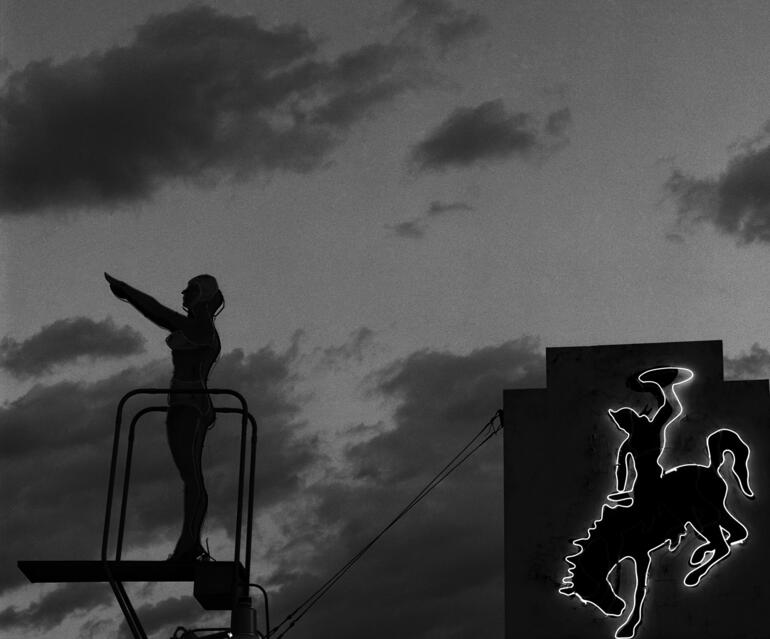
Motel Signs, Highway 80, Cheyenne, Wyoming, 1974
“I like the sign, the subject, in the context of its place,” says Fitch. Time is a key factor in all acts of photographing, and Fitch fondly recalls images he’s made in which a motel office clock is visibly clear and sharp, recording the exact moment and duration of his exposure.
Affinities have been suggested between some of Fitch’s work and the Bechers’ typologies—for their work’s scholarly value, the passionate quest to capture a changing landscape, and for their precise presentation practices. But the Bechers’ “objective” aesthetic, it may be argued, became their content, whereas Fitch’s content is essentially romantic, and takes advantage of photography’s ability to collect and compare.
Affinities have been suggested between some of Fitch’s work and the Bechers’ typologies—for their work’s scholarly value, the passionate quest to capture a changing landscape, and for their precise presentation practices. But the Bechers’ “objective” aesthetic, it may be argued, became their content, whereas Fitch’s content is essentially romantic, and takes advantage of photography’s ability to collect and compare.
His photographs of animated motel signage flashing invitations to travelers boasted rooms with air conditioning or TV; others featured lit-up outlines of women lounging by or diving into swimming pools. While his pictures from this period include few people, there is a strong human presence—Fitch’s—one lacking in pretense that celebrates his joy in the hunt and capture of these roadside oddities. The viewer never feels that one of Fitch’s pictures has been made as obligation or as a chore. Each one has the photographer’s intent and integrity intact. “Part of what’s been lost,” he says, “is that those signs were produced locally and were related to those specific places. Now, with the franchising of motel and fast-food chains, every town looks pretty much like all the others.”
Fitch’s most recent book, Screen Towers (George F. Thompson, 2025), is devoted exclusively to the architecture of drive-in movie theaters and their immediate environs. The book begins with early black-and-whites like those seen here, shot on medium-format film, and transitions to color photographs shot with an 8×10 view camera, for the most part, in natural daylight.
Fitch’s most recent book, Screen Towers (George F. Thompson, 2025), is devoted exclusively to the architecture of drive-in movie theaters and their immediate environs. The book begins with early black-and-whites like those seen here, shot on medium-format film, and transitions to color photographs shot with an 8×10 view camera, for the most part, in natural daylight.
Fitch’s compositions monumentalize the screen towers, and, as Kate Ware points out in her fine introduction to the book, Fitch had long before, “been thinking about the enduring architecture of the Mayan Empire, writing his undergraduate thesis on the use of infrared light to detect unlocated cities and ceremonial sites throughout Mesoamerica.”
Ware likens Fitch’s images of screen towers to color field paintings, and their qualities as beautiful objects of art and craft are both evident and undeniable.
Ware likens Fitch’s images of screen towers to color field paintings, and their qualities as beautiful objects of art and craft are both evident and undeniable.
Fitch’s work in cultural anthropology will endure, offering future generations with imagination the opportunity to enjoy and learn from his photographs; a chance to visit in the mind, anyway, a wonderland of sorts from not so very long ago.
Addendum
Addendum
One can see a wide range of this photographer’s work at stevefitchphotography.com. Among his numerous other series are Western Landmarks, Bushes, Vernacular Assemblages, Neon Sculptures, and many more. His books include Marks in Place: Contemporary Responses to Rock Art (University of New Mexico Press, 1988), Gone: Photographs of Abandonment on the High Plains (University of New Mexico Press, 2003), and American Motel Signs, Volumes I: 1980–2008; II: 1980–2016; and III: 1979–2018 (The Velvet Cell, 2016, 2020, 2022) / Steve Fitch and his wife reside in a passive solar adobe house they built together on rural land in New Mexico.